


Use Case: API
Modern and secure API integration
Summary
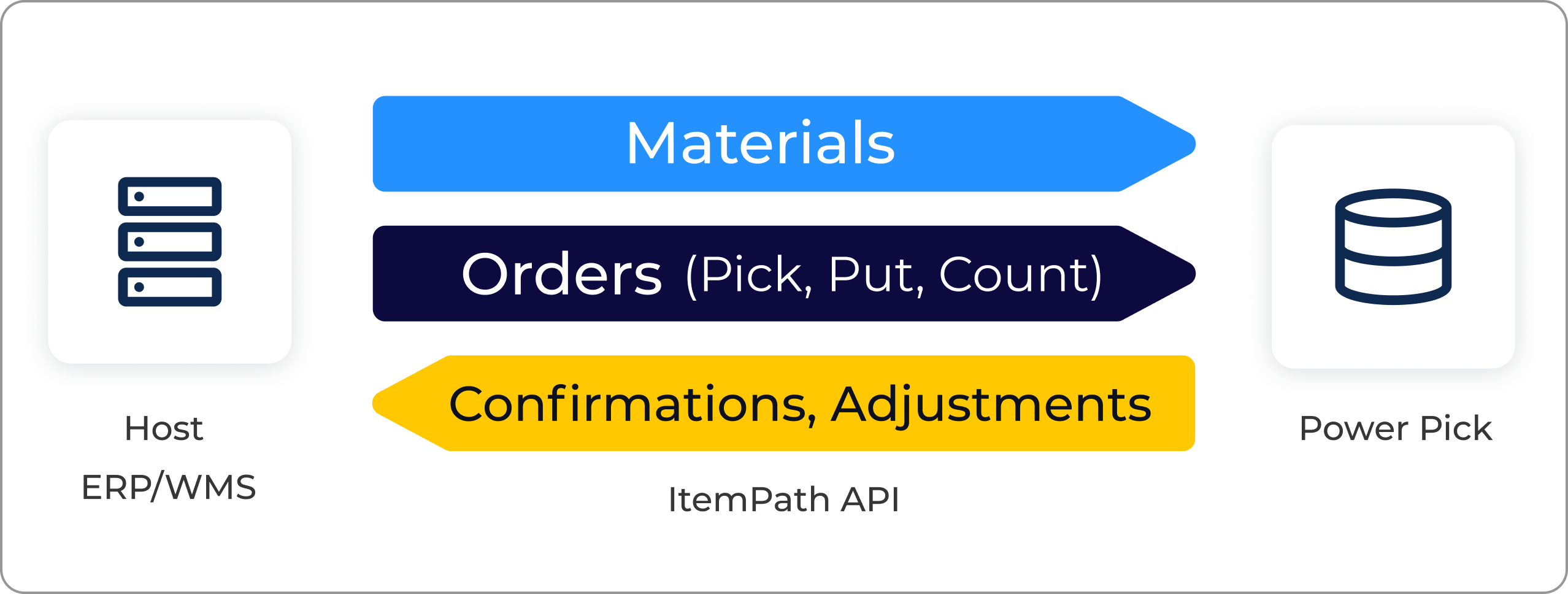
The ItemPath API provides a modern, secure, and reliable REST-based interface for seamless data exchange between the Power Pick system and external enterprise software like an ERP or WMS. It eliminates outdated data transfer methods, ensuring immediate updating of order and material information.
ItemPath has successfully integrated with many major ERPs, including SAP, Oracle, and Microsoft Dynamics 365.
Persona
Warehouse Managers, IT Developers, ERP/WMS Administrators
Challenge
Integrating specialized warehouse systems often relies on unreliable, insecure, or inefficient methods like file transfers or intermediate SQL tables, leading to data lag, complex debugging, and slower operational flow compared to modern software standards.
Feature and Solution
The ItemPath API transforms disconnected systems into a unified operation. As a fully-developed REST API for Power Pick, it offers standardized, efficient, and secure API endpoints for managing all resources (materials, orders, etc.) and facilitating bi-directional data flow. It accepts and passes data using the JSON format, offering a fast, reliable, and modern alternative with superior reliability, remote login, and immediate responsiveness compared to text or SQL tables.
Example:
A large distribution center, using SAP as their central ERP system, needs to create new picking orders in the VLM (Vertical Lift Module) immediately after a customer payment is processed.
ERP Initiates Order: The SAP system, acting as the external source, is configured to make a POST request to the relevant ItemPath API endpoint to create a new order in Power Pick.
API Processes Request: The ERP sends a JSON payload containing the required order details (e.g., name, materialName, quantity). ItemPath receives and validates the request, instantly creating the order in the warehouse system for processing.
Real-Time Confirmation: Once the warehouse operator completes the pick in the VLM, the API automatically executes a function to send a transaction confirmation back to SAP.
Inventory Update: The ERP instantly updates its inventory and order fulfillment status, eliminating the delay traditionally caused by waiting for end-of-shift reports or file synchronization.
Key Results and Benefits
By adopting the ItemPath API, organizations can seamlessly link their WMS/Power Pick operations with their enterprise software. The API doesn't just connect systems; it closes the information loop. Stop relying on outdated file sharing and SQL tables—it's time to close the gap between your core software and your warehouse efficiency.
Top Capabilities
- REST-based Architecture: Supports standard methods (GET, POST, PUT, DELETE) for complete control over materials, orders, and data lookups.
- Filterable Logging: Full logging and auditing with online visibility and filtering, not just a local text file.
- JSON Data Exchange: Uses the standard, lightweight JSON format for efficient data transfer.
- Faster Error Resolution: Errors trigger automated alerts along with detailed integration logs, which make it easier and faster for IT teams to track down errors. Remote access means instant visibility.
Operational Benefits
- Superior Reliability & Security: Utilizes OAuth 2.0 authentication, supports SSL/TLS, and offers industry-grade end-to-end encryption.
- Reduced Total Cost of Ownership: The API provides maintenance-free endpoints and a "set it and forget it" approach, offering a "future proof" method as major ERPs phase out older integration protocols.
- Accelerated Development: Developers work in a dedicated test license to safely develop and debug integrations without affecting production.
Additional Resources
To learn more about implementing the ItemPath API, here are some useful resources: